RE
Subject Vision
R.E. in Earl Spencer is taught through substantive and disciplinary knowledge to promote a deep understanding that reflects on our children’s beliefs and attitudes. They will understand that some hold beliefs different from their own and the importance of working, living alongside, and respecting the faith of those with different beliefs. This is achieved through six key concepts that build progressively, thereby developing a spiral curriculum.
As part of this approach, the children will be learning RE and worldviews through the disciplinary lenses of Theology, social Sciences and Philosophy. This integrated approach enables pupils to gain a deeper yet balanced understanding of the subject.
Intent
At Earl Spencer Primary School, we believe that it is important for all our pupils to learn from and about religion according to the Northamptonshire Locally Agreed Syllabus 2025-2030, so that they can better understand the world around them.
The aim of Religious Education and Worldviews in our school is to enable the children to engage in key questions around the world and the meaning of life by promoting critical thinking and empathy. They will also develop a range of religious and non-religious perspectives. They will learn how to evaluate the wisdom of different sources, formulating their opinions and responding thoughtfully and respectfully to other views. It will also enable the children to engage in respectful dialogue and participate positively in a diverse society.
Worldviews approach in RE: this syllabus adopts the concepts of ‘ worldviews ’ to encompass a wide range of beliefs and values that shape human understanding and experience, whether religious or non-religious.
Implementation
At Earl Spencer Primary School, we follow the New Agreed syllabus for Northamptonshire to deliver the curriculum and, in accordance, across all year groups, Religious Education will:
-
adopt an enquiry-based approach beginning with the children’s own life experience before moving into learning about and from religion.
-
provoke challenging questions about the meaning and purpose of life, beliefs, the self, and issues of right and wrong, commitment and belonging. encourage pupils to explore their own beliefs (religious or non-religious), in the light of what they learn, as they examine issues of religious belief and faith and how this impacts on personal, institutional, and social ethics; and to express their responses.
-
enable pupils to build their sense of identity and belonging, which helps them flourish within their communities and as citizens in a diverse society.
-
teach pupils to develop respect for others, including people with different faiths and beliefs, and helps to challenge prejudice.
-
prompt pupils to consider their responsibilities to themselves and to others, and to explore how they might contribute to their communities and to wider society. It encourages empathy, generosity and compassion.
-
develop a sense of awe, wonder and mystery.
-
nurture children’s own spiritual development
This is done through six key concepts, which build progressively, thus developing a spiral curriculum
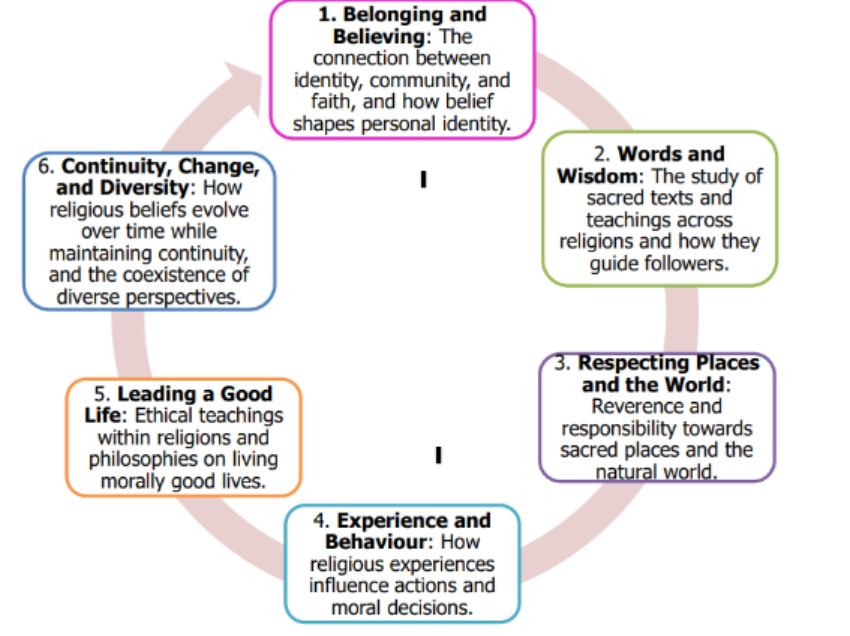
As part of this approach, the children will be viewing RE and worldviews through the disciplinary lenses of Theology, social Sciences and Philosophy. This integrated approach enables pupils to gain a deeper yet balanced understanding of the subject.
Impact
Through our Religious Education and Worldview curriculum, we believe that we encourage pupils to develop positive attitudes about learning and respecting the religious and non-religious beliefs, faiths, and values of others. It provides the means to celebrate the diversity of the school community and promote positive images of people in the wider community, including their beliefs, traditions, culture, language, and history.
It ensures that children develop spiritually, academically, emotionally, and morally to promote and realise a better understanding of themselves and others and to equip them with the opportunities, challenges and responsibilities of living in a rapidly changing, multicultural world.
Children will be able to:
-
To extend their knowledge and understanding of religions and beliefs, as well as to have a stronger awareness of the world around them.
-
To feel they are valued as individuals and that their beliefs are respected and celebrated.
-
To feel safe to learn new things and share their beliefs with others in an accepting, empathetic and relaxed environment underpinned by the values of Belonging, Respect, Curiosity and Pride.
-
To develop self-awareness and curiosity with the ability to make links between their own lives, customs, rituals and celebrations, and those of others in their community and in the wider world.
-
To respect themselves, their own religious views or non-religious views and others’ religious or non-religious views, opinions, customs and practices.
-
To develop open-mindedness and empathy by fostering life skills such as dialogue, investigation, evaluation, and reflection.
-
To acquire a religious vocabulary and interpret religious symbolism in a variety of forms.
-
To reflect on questions of meaning, offering their own thoughtful and informed insights into religious and secular worldviews appropriate to their age and cognitive development.
-
To explore ultimate questions of beliefs and values in relation to a range of contemporary issues in an ever-changing society, appropriate to their age.